
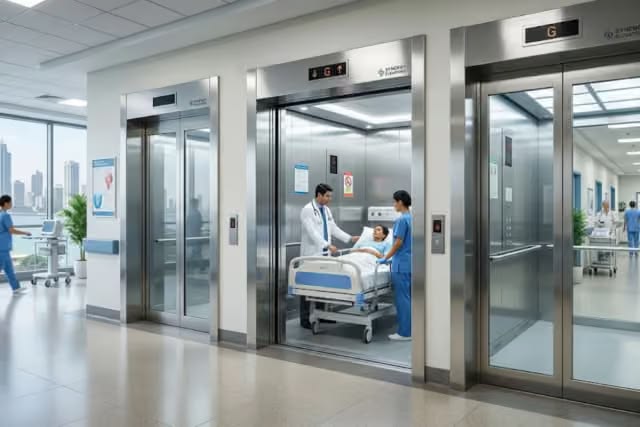
The hospitals will need efficient vertical transport mechanisms that will be able to accommodate patients, doctors, nurses, attendants, medical equipment, and even the hospital staff. Unlike the normal passenger elevators, there will be certain considerations in case of hospital elevators including convenience, sufficient room size, efficiency, cleanliness, and easy floor access.
It is advisable for the healthcare institutions to work with an experienced Hospital Elevator Manufacturer & Installation in Pinjore so as to be able to install an elevator that suits the specific needs of the institution in terms of design and capacity. JK Elevator Online offers elevators for hospitals and other specialized buildings.
Hospital Elevator: Definition
A hospital elevator refers to an elevator that facilitates the movement of patients, healthcare professionals, stretchers, wheelchairs, and other medical devices within a health care institution. The cabin is usually constructed in a manner that will make it easier to transport the patients.
All these depend on several issues including the size of the building, the number of floors within the structure, traffic, size of the stretcher, carrying capacity of the elevator, among others.
When choosing Hospital Elevator Manufacturer & Installation in Pinjore, there is need to consider the specifications and installation ability of the manufacture.
Why Hospitals Need Specific Elevators
Hospitals run 24 hours a day, so there is a need for smooth transit between various sections and different floors within them. There may be a need for patients to move from the emergency department to an operation theater or ward or any other section of the hospital.
Hospitals elevators can transport:
- Patients and attendants
- Wheelchairs
- Stretchers
- Medical instruments
- Doctors and nurses
- Hospital staff
- Medicines and supplies
- Housekeeping instruments
This is why hospitals require specific elevators for health care logistics instead of normal passenger elevators.
Key Characteristics of Hospital Elevators
Hospital elevators should be reliable and designed for use within the healthcare facility.
Large Cabin Capacity
Having large enough cabin space allows for easy accommodation of stretchers, wheelchairs, attendants, and other equipment.
Smooth Riding
The ability to accelerate and brake smoothly allows for safe patient transportation.
Reliable Doors
Reliable doors allowing to open enough space for stretchers and wheelchairs depending on the chosen elevator model are needed.
Interior Easy to Clean
Hospital elevators should be cleaned regularly. Proper finishes of the cabin will help in doing it.
Emergency Use
Hospital facilities require availability of elevators. Proper emergency and backup systems will allow it under certain circumstances.
Sturdy Design
Hospital elevators can be used frequently. The right materials and engineering will provide reliable elevator use.
Uses of Hospital Elevators
Hospitals’ elevators can be applied in different healthcare centers.
Multispecialty Hospitals
Multispecialty hospitals can apply hospital elevators in linking various departments located at different floor levels including emergency, wards, operation theater, laboratory, and other facilities.
Nursing Homes
Nursing homes can utilize appropriate hospital elevators for the transport of patients and staff members and those in wheelchairs.
Diagnosis Centers
Diagnosis centers can apply hospital elevators for transportation of patients from one point to another for diagnosis purposes.
Medical Colleges
Medical colleges and hospitals can utilize elevators in accessing different places in the facility including laboratories and lecture rooms.
Rehabilitation Centers
Rehabilitation patients may require easy access vertically while using wheelchairs and walking aids.
Hospital Elevator Selection
Each healthcare facility has different needs. In order to select an appropriate elevator, several criteria must be taken into consideration.
1. Passenger and Load Capacity
Calculate the number of people and loads that will be carried by the elevator.
2. Stretchers Size
In case the patients have to be moved using stretchers, the dimensions of the elevator's cabin and entrance must suit the size of the required stretcher.
3. Floor Levels
Number of floor levels and distance of the travel play role in the selection process.
4. Traffic Needs
Hospital usually has a large volume of traffic at visiting, emergency, shift change, outpatient hours, etc.
5. Cabin Interior Layout
Interior layout must allow easy access for patients, attendants, wheelchair and medical personnel.
6. Safety Requirements
Safety equipment must be selected depending on the design of the elevator, building and other regulations.
Installation of Hospital Elevator in Pinjore
Professional installation is necessary for ensuring reliable performance of hospital elevators. This installation procedure starts with site evaluation.
This can involve the following tasks:
Site Evaluation: Evaluation of shaft dimensions, pit condition, floor height, electrical needs, and access provision.
Requirements Assessment: Determination of elevator carrying capacity, cabin size, lifting height, stopping floors, and use.
Design and Manufacturing: Design and manufacturing of elevator parts based on requirements.
Installation: Installation of elevator parts, doors, controls, cabin equipment, and safety equipment.
Test Run: Testing of elevator performance with regard to movement, door functionality, controls, leveling, and safety features.
For hospitals, installation requires additional considerations of traffic and department location.
Safety Aspects for Hospital Elevators
Safety becomes a very important aspect in the healthcare industry since patients with restricted mobility might travel using hospital elevators.
Aspects that should be taken into consideration may include:
- Door safety system
- Protection from overload
- Emergency alarm
- Emergency lighting
- Proper communication system
- Accurate floor leveling
- Braking system
- Emergency power supply system if needed
- Cabin size
- Acceleration/deceleration control
The exact systems that will be necessary to install depend on the model of the elevator, building construction, regulatory requirements, etc.
Advantages of Working With an Experienced Manufacturer
When working with an experienced Hospital Elevator Manufacturer & Installation in Pinjore, the entire project can become much easier.
An enterprise having capabilities for design, production, installation and maintenance will be able to organize all aspects of the elevator project.
Major advantages can be the following:
- Application-specific design
- Elevator customization
- Professional installation
- Testing and commissioning
- Preventive maintenance
- Technical support
- Spare-parts assistance
- Breakdown assistance
Such an integrated strategy may be very useful for hospitals, where the efficiency of the elevators plays a critical role.
Why Should You Select JK Elevator Online?
JK Elevator Online offers elevators that can be used in residential, commercial, industrial, hospital, and other special purposes buildings. They provide services like manufacturing, installation, testing, and maintenance according to the need for elevators. In case of healthcare projects, the elevators can be designed keeping in mind the aspects of patient transport, stretcher access, cab size, traffic, building design, and safety.
For customers interested in getting an Hospital Elevator Manufacturer & Installation in Pinjore, they can share their building specifications with JK Elevator Online and get the most appropriate configuration of their elevators.
Hospital Elevator Maintenance and Long-Term Support
Elevator installation is just the start point of its operation cycle. Regular servicing will ensure smooth functioning of the mechanical, electrical, control, and safety parts. Maintenance schedule can be useful for the management of the hospital to keep track of the status of the elevator. Service records and timely inspections are essential for facility managers.
Conclusion
The elevators within hospitals help transport people, including the patients, hospital staff, attendants, stretchers, wheelchairs, hospital equipment, and even materials in and out of the building. They should be built keeping in mind efficiency, adequate capacity, smooth transportation, safety, and accessibility.
Working with a professional Hospital Elevator Manufacturer & Installation in Pinjore can help healthcare centers deal with all the issues related to elevators, right from site assessment and custom design to the process of installation, testing, and maintenance.
JK Elevator Online provides elevators for the healthcare and other specialized applications. Considering the various factors like cabin requirements, capacity, travel height, hospital traffic, and safety, healthcare centers can come up with a proper elevator solution.


